
About Us
Our Story
Idaho Born and Raised
Pete Wimer was born in rural Idaho and has been building since he was a little boy and discovered 2x4s a handsaw, a hammer and some nails. Having spent the first part of his young adult life as a missionary, he did a lot of fine wood work, making chapels and chapel furnishings in the eastern United States and Europe. During this time he earned an associates of the arts in Classical Studies and a bachelor’s degree in systematic philosophy in Rome, Italy. He is fluent in several languages and a constant student. Back state-side in his late twenties, he joined on to an electrician for a few years and then detoured into financial advising for the better part of a decade. But the whole while sawdust and woodchips kept calling at his heart and he could never quite put down his tool belt.
When his brother died of cancer, the time came for Pete and his young family to make big life changes, and before he could make up his own mind on it, several people approached him to build various things, from bathroom vanities to whole houses and a few outbuildings. Taking it as a sign and open door, Grace Builders LLC was officially formed and they have been building new homes, shops, greenhouses and even occasional steel buildings.



What To Expect
Our Process
We work together with you and your architect and designer to help you make the decisions early on
that will expedite the whole building process. This helps greatly to make sure there are no budgeting
surprises. This is also the critical moment where the decisions are made regarding the quality of the
components of your home. If you do not yet have a designer or architect, we can help in that process as
well.
We offer a blend of self-perform and management style home construction. When we self perform projects we are able to have our own crews doing the bulk of the work which can lead to a more streamlined project. On other projects we determine that a management style of leadership is more critical. This management style lets us select highly specialized tradesmen for each phase of your home's construction. This is critical especially for higher end homes that require expert level craftsmanship at each phase of the process.
Frequently Asked Questions
FAQ
This is probably the most frequent question I get from the curious and the serious alike.
The answer to it can vary dramatically based on many factors. I’ve built homes for under
$200/foot and others can easily exceed $600/foot. Many times a client will already have
a well and septic system installed before the home construction begins and so these are
then costs that do not necessarily get rolled into that price per foot calculation. And
then there is the whole topic of the house plans. Some houses are simply more
complicated and take longer to frame. Others are built on difficult terrain that can make
everything more time consuming. The structural quality architectural nuances of a home also impacts its initial
cost although that is often quickly recuperated due to the home’s lower operating costs
and higher quality. If you are
looking to price a home, feel free to reach out to me directly or fill out the form on the contact page.
It is very important to remember that building a home makes almost every single list of
the top five or six most stressful events a person can go through. The more custom the
home, the more that tends to ring true, especially if not designed all the way through
even down to every paint color and flooring element selected. So choosing a builder is a
very important decision that can give you and your spouse a wonderful year of
adventure, or a 24 month nightmare that could end in litigation and lots of
heartache. (I’ve cleaned up a project where the clients and original builder split and it
was not a situation I’d want to see anyone in again.) But how do you pick a builder?
Demonstrable skill is critical and easy to obtain. The other, harder to define element is
trust. Can you trust him to give his best for you? Can you trust him to steward large
amounts of money in the process of building your home? Do you agree with his ethics?
With all my prospective clients, we first meet and go over plans and spend some
time getting to know each other and what to expect over the course of the
building cycle. This gives my clients a chance to get to know me and gives me a
chance to get to know them and mutually determine if we are going to be a
good fit.
We operate primarily in the Grangeville/Cottonwood area as well as in Sandpoint and surrounding areas.
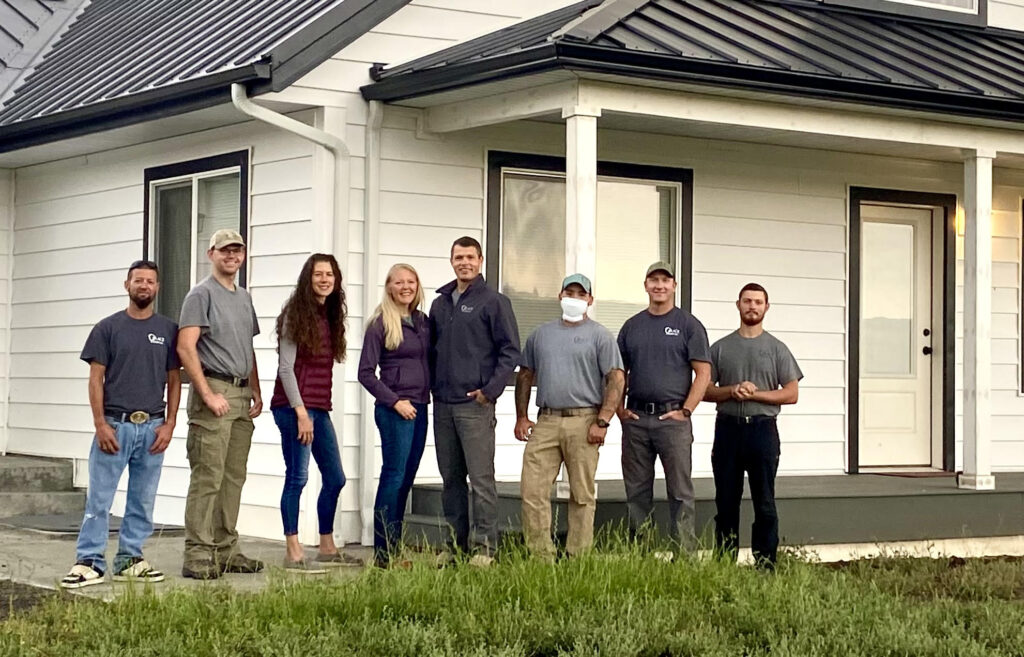
We recently built a house for a family with young children. The mother commented to me as we were finishing up the build that she felt more comfortable with her children around our crew than around some family members because of the respectful and courteous language that always was present on our job site.
